 English
 Dansk
 Deutsch
 Español
 Norsk bokmål
 Svenska
Project accounting means two things in a project-based business, whether you build, install, design, manufacture to order or deliver consulting and IT projects. It is a legal requirement: building, construction and shipyard businesses must be able to document revenue and costs per contract. It is also a management tool: the figures that show how a project will end while you can still change the result.
Two meanings of project accounting
| Project accounting under the Bookkeeping Regulations | Project accounting for management | |
|---|---|---|
| Purpose | Documentation and control: revenue and costs per contract can be checked | Decisions: how the project will end, and what we can do about it |
| Looks at | What has been posted | What has been posted, what is ordered and what remains |
| Who | Accountant, auditor, Skatteetaten (the Norwegian tax authority) | Project manager, managing director, board |
| How often | At least every four months | Every week or every month |
| Requirement | Mandatory above 5 G for building, construction and shipyards | Not required, but this is where margin gets saved |
The two are connected. Project accounts that meet the regulations are the foundation: without correct coding and accruals, no forecast will be any good. But project accounts that only meet the regulations just tell you what has already happened. To manage a project you also need what has been ordered and what remains.
When is project accounting required?
Chapter 8-1 of bokføringsforskriften (the Norwegian Bookkeeping Regulations) has its own rules for building, construction and shipbuilding. Under § 8-1-3, project accounts must be kept for contracts where the tender price or estimated turnover is at least five times the National Insurance basic amount (5 G), excluding VAT. The threshold was raised from NOK 300,000 with effect from 27 June 2024. With the basic amount from 1 May 2026 (NOK 136,549), the threshold is NOK 682,745. It is adjusted every year.
The rules cover building and construction contracts, including fixed technical installations such as ventilation and lifts. Pure supply of goods, design and consulting fall outside them, as do installations that make up less than 5% of the total contract value. A general contractor is covered even if all the work is subcontracted. If you are unsure whether a contract is covered, check with your accountant or auditor, because the line can be a matter of judgement.
The duty in chapter 8-1 applies to building, construction and shipyards. Engineering firms, manufacture to order, IT and consulting have no special duty to keep project accounts under the regulations, but they have the same need to manage profitability per project, and the same questions about when to recognise revenue on a contract that runs over several months.
What the project accounts must contain
Under § 8-1-4, the project accounts must identify the project by project code, client, type of work and start and end date, and show all direct costs and all revenue. Costs must at least be split into wages, materials, subcontractors and other direct costs. Contract work must be kept apart from additional work and changes where that is material. The project code must be on every posting, and the project accounts must be updated for each reporting period, at least every four months.
Two other rules in the same chapter are just as practical. Under § 8-1-2, timesheets must be kept per employee and per day, split between projects and internal time, even on fixed-price contracts. And under § 8-1-5, the project accounts, contracts, drawings and timesheets must be kept for ten years, against five years for most other accounting records. The project accounts must also have an audit trail in both directions: from posted entry to project and from project to posted entry.
| Requirement | Legal basis | In practice |
|---|---|---|
| Project accounts above 5 G | § 8-1-3 | All contracts above about NOK 683,000 excl. VAT from 1 May 2026 |
| Costs by wages, materials, subcontractors, other direct | § 8-1-4 | The chart of accounts and budget lines must add up to these four |
| Contract and changes kept apart | § 8-1-4 | A separate line or subproject for changes |
| Updates at least every four months | § 8-1-4 | Most do it monthly |
| Timesheets per employee and day | § 8-1-2 | Also on fixed price |
| Retention for ten years | § 8-1-5 | Contracts and drawings too |
Invoicing by progress and VAT
In building and construction, sales documents can be issued as the work progresses (§ 8-1-2a). If the contractor receives a part payment, a sales document must be issued no later than one month after the end of the VAT period. Skatteetaten has made clear that purely financial advances before work starts give neither a right nor a duty to issue a sales document, but an advance becomes a part payment as soon as the work is under way. It must then be invoiced with VAT as the work progresses. VAT belongs to the period in which the sales document was issued, regardless of when the customer pays.
So invoicing is more than a cash question. Completed work you have not invoiced is credit to the customer, and it can turn into a VAT problem if you have received payment without invoicing.
Revenue by progress: the percentage-of-completion method
The main rule in Norwegian generally accepted accounting practice for construction contracts is the percentage-of-completion method (løpende avregning) under NRS 2 Anleggskontrakter, the Norwegian standard on construction contracts: revenue and profit are recognised in step with the percentage of completion, not when the customer is invoiced and not when the project is finished. Small companies can instead use the completed contract method under NRS 8, where revenue is recognised when the contract is completed and costs incurred are held on the balance sheet as work in progress until then. The choice of method is made for the company as a whole and must be applied consistently, so agree it with your auditor.
The percentage of completion should reflect the work actually done. The most common measure is costs incurred divided by forecast total costs. If that gives a misleading picture, for example because expensive equipment has been delivered but not installed, physical measurement or labour hours can be used instead. Contract revenue is the contract sum plus approved additional work and changes. Changes are included when the customer is likely to approve them; claims for compensation have stricter conditions. And if the final result cannot be estimated reliably, as is often the case early in a project, revenue is recognised equal to costs incurred, so the result is zero. In other words, a project without a forecast cannot take a profit.
Worked example
Take a project with a contract sum of NOK 4,800,000 excl. VAT, running from March to January. The customer has approved one change order (CO-03) of NOK 78,000, so contract revenue is NOK 4,878,000. At 31 October 2026, costs incurred are NOK 3,242,200 and forecast total costs are NOK 4,573,800. Incurred here means that the cost has been taken on and belongs to the period, not that it has been paid.
| Amount | |
|---|---|
| Percentage of completion: incurred ÷ forecast total cost | 70,9 % |
| Earned revenue: percentage of completion × contract revenue | 3 457 836 |
| Invoiced on account to date | 3 120 000 |
| Earned revenue not yet invoiced (a receivable on the balance sheet) | 337 836 |
| Profit to date: earned − incurred | 215 636 |
| Forecast profit for the whole project | 304 200 |
On the balance sheet, earned revenue not yet invoiced is shown as a receivable. If the customer has been invoiced for more than has been earned, the excess is shown as an advance from the customer under current liabilities. Receivables and advances on different contracts must not be offset against each other.
What the choice of method means for the annual result
Over the life of the project the result is the same. The difference is when it shows. For a company with many projects running over the year end, the result under the completed contract method swings with when projects are handed over, not with how much work has actually been done.
Loss-making contracts: the whole loss at once
If the forecast shows that a project will make a loss, the whole expected loss must be expensed immediately, not spread over the remaining work. This applies under either method. In the example, own labour hours on installation are heading for 2,020 against 1,750 in the estimate, and each extra hour costs NOK 620. If installation ends at around 2,511 hours, the project breaks even; any more and it is a loss-making contract. A project manager who knows the loss is taken at once has a good reason to update the forecast honestly and early.
From project accounts to project control
The table shows the example project line by line. The “ordered, not invoiced” column is what statutory project accounts do not show, and the “remaining, not ordered” column is the project manager’s judgement. Together they produce the forecast.
| Line | Original budget | Current budget | Incurred | Ordered, not invoiced | Remaining, not ordered | Forecast | Variance to current | |
|---|---|---|---|---|---|---|---|---|
| 4110 | Main equipment | 1 180 000 | 1 180 000 | 1 160 000 | 0 | 0 | 1 160 000 | +20 000 |
| 4120 | Materials | 820 000 | 880 000 | 560 000 | 210 000 | 140 000 | 910 000 | −30 000 |
| 4130 | Components | 420 000 | 420 000 | 260 000 | 150 000 | 30 000 | 440 000 | −20 000 |
| 4500 | Subcontractor | 300 000 | 300 000 | 120 000 | 216 000 | 0 | 336 000 | −36 000 |
| 4900 | Preliminaries | 140 000 | 140 000 | 98 000 | 0 | 52 000 | 150 000 | −10 000 |
| 5110 | Installation, own hours | 1 085 000 | 1 085 000 | 880 400 | 0 | 372 000 | 1 252 400 | −167 400 |
| 5120 | Project management | 202 800 | 202 800 | 163 800 | 0 | 62 400 | 226 200 | −23 400 |
| 5130 | Commissioning and handover | 99 200 | 99 200 | 0 | 0 | 99 200 | 99 200 | 0 |
| Total | 4 247 000 | 4 307 000 | 3 242 200 | 576 000 | 755 600 | 4 573 800 | −266 800 |
Five things explain the drop. Own labour hours on installation are heading for 270 hours over the estimate. That is the largest single variance, and the most common one in nearly every project-based industry. Materials are over even after the budget was raised by NOK 60,000 through change order CO-03. The subcontractor was engaged for 336,000 against 300,000 in the estimate, a loss locked in the day the contract was signed. Preliminaries cost more because the work took three weeks longer. And project management has used more hours than planned. The main equipment came in slightly under, and the change adds some margin, but not enough.
Original budget, current budget and forecast
The materials line had NOK 820,000 in the estimate and 880,000 in the current budget after CO-03. The forecast is 910,000. Against the current budget the variance is −30,000; against the estimate it is −90,000, of which 60,000 is covered by the change. Both figures are useful. The first shows what is still to be put right; the second shows what the estimator should learn. Project accounts with only one budget lose one of these two stories. A budget adjusted without a log hides variances instead of explaining them.
Changes not yet agreed
Change order CO-04 of NOK 120,000 has been notified but not approved. It is not in the forecast. If it is approved, forecast profit becomes NOK 424,200 (8.5%). Show it as a separate figure. It is both a risk and an opportunity, and someone has to own the follow-up.
From posted costs to forecast final result
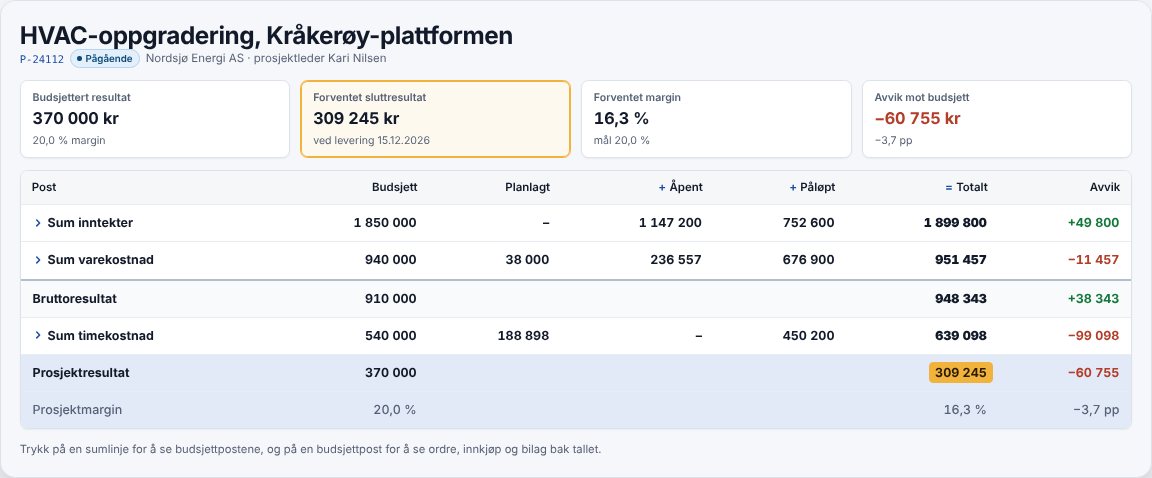
The Profitability tab in ProfitTracker is built on the same calculation as the table above: Planned + Committed + Actual = Total, compared with the budget per budget line, for revenue, cost of goods and labour cost. Actual is posted entries fetched from the accounting software, completed stock withdrawals and logged hours at their hourly cost. Committed is purchase orders and order value not yet invoiced. Planned is what is still to be ordered and the hours remaining. Every total line can be opened down to the purchase order and posted entry.
Two caveats. Entries are fetched in the daily sync and when you press “Synchronise now”. And remaining hours are the estimate minus logged hours, so the forecast is only as good as the estimate the project manager keeps up to date. Earned revenue by percentage of completion is calculated in the accounts; ProfitTracker gives you the forecast you need to do it.
Project contribution and operating margin are two different measures
The result in project accounts is a project contribution: revenue minus direct project costs. It has to cover overheads such as premises, administration, sales, tools and management before it becomes operating profit. That is why you cannot compare the project margin directly with an operating margin. You can, however, use the operating margin as a yardstick for how much variance a business can take: overheads do not change when a project slips, so any fall in project contribution comes straight off operating profit.
In the example, the project contribution falls from 11.5% to 6.2%, which is 5.3 percentage points of the project’s revenue. BDO’s building and construction analysis for 2026 shows an operating margin of 5.1% for building services contractors in 2025. If a company has about that margin and several projects slip by as much, the year’s profit is gone. That is why a few percentage points on a few large projects decide the year.
Period close: four steps every month
1. Coding
Go through entries with no project code or on the wrong line. “Miscellaneous” counts as documented, but it is useless when you need to find the cause of a variance.
2. Accruals
Goods received but not invoiced belong to the month they were received. In the example that is NOK 64,000 of materials delivered and used without an invoice. The same goes for subcontract work done but not invoiced, and for hours logged but not yet paid.
3. Forecast
Update what remains per line, especially hours. Assess changes by status. Ask whether the project is a loss-making contract.
4. Revenue and balance sheet
Calculate the percentage of completion, earned revenue and the difference against what has been invoiced. Reconcile with the invoicing plan: is there work that should have been invoiced?
Final account and post-project review
The project accounts do not close at handover. Under NS 8405 and NS 8407, the final account must be submitted within two months of handover, and the client then has two months to pay and raise objections; other contracts may have other deadlines. If experience tells you warranty work costs money, you must make a provision for it when it is likely. Still, what matters most for the next project is the post-project review: where did the estimate miss on hours per unit, purchase prices, subcontractors and preliminaries? This is where project accounts turn into better tenders.
ProfitTracker fetches posted entries from the accounting software and adds purchase orders, planned purchases and remaining hours on top, so you can see forecast profit per project while it is running.
Sources
- Skatteetaten – changes to bokføringsforskriften (5 G)
- Skatteetaten – the basic amount from 1 May 2026
- Revisorforeningen/Revregn 4/2026 – project accounts in building and construction
- Skatteetaten – shorter retention periods (project accounts 10 years)
- Skatteetaten – settling advances in building and construction (2022)
- Skatteetaten – BFU 9/2026
- Regnskapsstiftelsen – NRS 2 Anleggskontrakter
- Regnskapsstiftelsen – NRS 8
- Revregn 3/2023 – loss-making contracts
- CMS – final account
- CMS – defects and complaints
- BDO – Bygg- og anleggsanalysen 2026